RannaGhor

I am a bengali who has discovered the joy of food 3000 miles way from homeland. RannaGhor(means kitchen in bangla) is an attempt to share my kitchen experiments with like minded people out there. I love cooking ...it is my way to destress or to simply satisfy my taste buds. I am one of those who live to eat.
Showing posts with label Dessert. Show all posts

Friday, 13 January 2012

Steaming Dessert (Bhapa Doi)


Bengal is famous for its mishit doi. The statement which follows the proclamation of being a bengali is ..”oh rosogulla and misti doi”. But while misti doi rakes in the fame, its cousin ‘bhapa doi’ gets the silent treatment. To be fair, I myself had not tasted one until my mid-twenties and that to not at home. In fact I have never tasted homemade misti doi ever! That is weird. Guess it is because it is so easily available in shops in kolkata.

The first thing I learned on coming to Uk was about yoghurt. Different texture (greek, set), flavour (strawberry!!, mango, passionfruit) and of course health conscious probiotic ones. I had never ever seen so many at one place. In fact never had store bought yoghurt till we set up a rented home in first year of job. I was quite surprised on my recent visit to a delhi supermarket to see a similar range. I never liked it at home..it was always a watery kind of thing. Boil the milk, cool it, add the sample (jamun..it was called) and let it to grow itself into a sour mess. In an Indian kitchen where overnight food was looked down upon it is wonder how a fermented item is so important. I did a bit of search on this. It turns out to be quiet a nutritious thing. And in term of ayurveda dahi has some of the biggest digestive capabilities. That explains why it is a component when we have rich and indolent food. Biryani is served with raita, curd rice is a preferred food item with chilli laden fares of the south india and finally as a tenderizer and gravy base in dishes like Mutton/ chicken rezala.

But this lactobacillus treated milk has changed the retail market in the last few decades like no other product. Hardly anybody I know set their own yoghurt. There was a recent feature on the telly about the European yoghurt market. It was a revelation! There is a billion euro worth of retail industry around this ‘afterthought’ of food.

I quiet like yoghurt-y desserts.. They do not have the diabetic level of sugar involved and the tinge of sourness is refreshing as well. They are easy to make ( i.e. assuming you don’t belong to the old school of setting your own dahi).

If you have survived on my treatise on yoghurt, then I am honoured. You will be duly rewarded with the light and fluffy bhapa doi recipe in down below.


Ingredients

  • 250 ml of set yoghurt ( I use onken)
  • 5 tbsp condensed milk
  • 3 cardamon pods crushed
  • 5-6 pistachios slivered for garnish
  • Optional
  • Sugar (accordingly to taste)
  • Saffron 5-6 strands
  • 2 spoonful milk powder
  • 2 spoonful milk powder


Use a light tea towel or a square cloth from some old cotton scarf. Pour the yoghurt in and twist the cloth to make a potli. If you are planning this in advace tie the cloth to your washbasin tap to drain overnight. If pressed for time, like I always am..put it in a colander and fill up a heavy saucepan with water and put on top of this. Leave for at least an hour. More is better. I put the colander into a plate or big bowl and the use the liquid coming out for buttermilk.

Overnight or a couple of hours later add all the items on the ingredient (except the pistachios) and mix to a smooth consistency. You may want to leave items out depending on your taste. I sometimes do not use cardamom as it seems a common enough taste in sweets made by me. Sugar again is subjective. After the condensed milk you would need a spoon or too at the max anyways. Ensure that the sugar is not granulated. You can use castor sugar is you want. If you used granulated then it ends up spoiling the texture when we bake the doi.

Set you oven to 180 degrees or gas mark 6 for 10 mins to warm it up.

Now put small cake grease proof paper into the ramekins, if you do not have ramekins or cake moulds, do not worry. You can make do with any bowls (preferably small size). The cake-paper mould have two advantages. One they allow the wobbly bhapa doi to come out of the ramekins easily, two they give a nice ribbed texture to the sides.

Pour the prepared mixture into the bowls or ramekins you have selected. Fill the mixture only till halfway point. If you give it a lot of height it might fall over during serving.

Fill a baking tray with water such that when you place the bowls in it, the water level outside is same as the yoghurt level inside. Now there are two roads to take. You can cover the bowl with aluminium foil or leave it open. I have tired both and found it tastes same either ways. Maybe I am not doing something correct. You might want to try some both ways.

Put the baking tray in oven and let it cook for at least 30 mins.

You know its done, if you see the mixture leaving the sides of the mould. The idea is to evaporate all the water of the doi and cook the mixture to a pudding consistency with a jelly like wobbly aspect to it.

Be very very careful when taking out the tray. I have ended a couple of my trials with the final product taking a dunking in the water at this stage. As the water would be hot by this time so it can spill over you as well.


If you have used paper mould inside bowls or ramekins the next step is easy. Just pick up the cake mould and put a small plate over it and turn it around. Take off the paper.

Alternatively if you are working without the paper mould, you can serve it without doing anything more.

Garnish with sliced pistachios and strands of saffron for the lovely golden tinge.


Thursday, 1 July 2010

Meddling Mandarin (Payesh with Mandarin pieces)

Food compliments our moods. When we are happy we want to eat good things, when we are sad, it doesn’t matter what we eat. Even festivals have an unique item associated with them. Durga pujo means khichuri, Makar Sankranti means til-gud, Id means sewaiyan, holi means gujiya, ganesh chaturthi means modak. Janmashtami probably needs a whole section of a recipe book to itself. It does not stop at cooked food. As children we were not supposed to eat kool (ber) till saraswati puja. It was explained that Ma Saraswati would be happy with our sacrifice and bless us with infinite wisdom. To me, it seemed a big price to pay for few marks in exam. But with the martinet Indian educational system you can never be too sure, a few extra marks never did any harm. I however think it was just a roundabout way of keeping the children off unripe kool (ber) so that they didn’t fall sick. After saraswati puja the fruits are well ripened. My mom would make kuler achar(Berry pickle) which we could then gorge on for quite a while to come. Coming back to sweets, there is however one sweet which is universal. Payesh. It comes in different formats depending on the region or even the house it is cooked in. But the basics remain the same.

Payesh is very integral to Bengali celebrations. Whether it is a jonmodin (birthday) or ai-budo-bhaat (part of pre-marriage ceremony), or saadh (baby shower) payesh is a must. Payesh is what we call Kheer in bangla. Kheer means something different in Bangla, it is the lump left after simmering milk for hours...a type of khoya. Among the sweet courses of Bengali cuisine, payesh is considered a different type of sweet than sandesh/doi or rosher misthi(sweets with chashni, or sugar syrup). There were at least 3 different types cooked frequently in our home. Batasha diye payesh. Khejurer guder payesh. Channar payesh.

My dida makes the best payesh. Our annual visit to mama-r badi (mom’s maiden home) was considered an event important enough to warrant this payesh. In the sprawling house one big room was reserved for pujo ghor and my dida would cook a full Bengali meal everyday as part of the pujo. The general household cooking was done by the other female members of the family. I remember hovering around the door (I could not go in till I took a bath) of the pujo ghor to find out what was on menu that day. She used gobindo bhog chal in it. I came to know this only recently. The granules of this rice are very small and fragrant. It lends a whole new dimension for the taste buds to explore. She would use batasha (a type of sugar candy used for religious ceremony) for sweetening rather than sugar. The consistency of the milk was thick, the rice melted in my mouth and the whole thing left a lasting taste. There was a strange sense of well being after eating it. My payesh does not come close to it. I think she did not tell me about the dollops of tenderness and affection that she added.
Bangla is known as the sweetest language. With so many sweets consumed can it be otherwise?

This recipe is as traditional as you can go with payesh, but with a twist I learned from an aunty. We call it Mandarin Payesh and it is a favourite of AS. I can hardly manage to snatch a few spoonfuls if he gets his hands on it first :-).

Mandarin Payesh (Rice pudding with mandarin pieces)

2pints milk
½ cup rice
1 cup sugar (depending on how many sweet teeth you have)
4-5 Cardamom (powdered would be better)
1 small tin Mandarin

Optional
2 tsp chironji dana
¼ tin condensed milk

Take a heavy bottom pan and let the milk come to boil in it, then keep on medium heat and keep stirring every few minutes so that it does not stick to the bottom. I generally use the pressure cooker for this. I add the condensed milk after the first boil. It allows the milk to thicken fast. If you prefer to you full-fat milk then you would not need condensed milk. If you do not have condensed milk, you could add 2 tbsp milk powder. Be aware than the taste differs between condensed milk and milk powder.
Meanwhile, wash and soak the rice in water. This softens the rice and reduces the cooking time. I managed to heave 1 kg of gobindo bhog chaal (rice) all the way from Calcutta to London. Basmati rice does not give the same texture in payesh as this rice. But you could go for very small grained rice, if you cannot get hands on the gobindo bhog.
After simmering for 15 mins, add the rice in. If you are going to add whole cardamom, then add it now. Let it cook on low heat, till the rice is done. It generally takes me about 25-30 mins to get the rice to be soft. It should so soft, that you can easily press it between thumb and forefinger without apply much pressure. At this stage add the cardamom powder and chironji and the sugar.
Let this cool down. Meanwhile take out the mandarin pieces and add 2 tsp of sugar to it and microwave it for about a minute. Remove the pieces and keep separately. We do not want the juices going into the payesh.
When the payesh has cooled down, stir in the sweetened mandarin pieces into it.
That is it. Keep in fridge and you can easily enjoy for a few days, though I have to admit mine doesn’t last that long.
Happy eating..

Sunday, 11 April 2010

A toast to friendship

There are days when you are so happy that you want to share...with everybody and anybody. Today is one such day. My best friend is expecting a. It may not be so normal to experience such huge joy for someone else addition to family. But I do ..I feel it so fervently..I wish I could whiz by the oceans and landmass separating us to just give her a hug. Fifteen years is a long time. And we are still best friends. Glancing back there are so many memories. When I sometimes acknowledge the speed with which life has changes in past few decades, it is these old school memories of mine which are a comforter.
They were the days on edge of innocence. And I am glad to say I weathered it well. Without becoming bad and cynic. Well bad is a very subjective word anyways. But at least my parents never felt I was becoming wayward. I was blessed with a good bunch of friends with share passion and interests. And that is perhaps the reason we have stayed such good friends. With them i realize that you do not need to talk everyday, share every bit to remain friends. Beyonds oceans and distances, if we school friends talk over phone or exchange one email..it is like old times.
We went our separate ways after school. But there was a reunion, 5 years later. And what a riot it was. We were 6-7 of us back for 3 days in the same surrounding we had spend four best years of our lives. Those three days are a real treasure for me now. We gossiped into the early hours of the morning, lunched at our old school canteen and drove into the mountains. In some ways the days whizzed by and in others they are so full of memories that they feel stretched out. I am just glad that it happened. And now the second one from that group is going bring another life into this world. It is incredible and yet so commonplace.

I may go on rambling in this manner without thinking that few of you might be waiting for the recipe. Well since we are talking all baout friends today, let me share one recipe from a friend of mine(from another four fun filled years of graduation), who has inspired me to start cooking cakes again.

About 7-8 years back I used to make cake. At the time i didn’t even know how to cook tea, i cooked cake. The reason being it did not involve going near the stove/gas. My father feared my I would leave the outlet open or something of the sort. But fortunately we had a solar cooker. So you see we were doing your bit for environment at a time when global warming was not a buzzword. Though I have to admit , my mother didn’t have the patience to cook a full meal in solar cooker. She wanted to get the cooking bit finished in one go. Not wait for 30 mins for the lentils to boil, another 30 for them to cook with seasoning. So it was in this neglected solar cooker that I started making cakes. I cannot remember who taught, perhaps would have been another friend :-). But I would beat the cake batter to death (there were no whisking attachments in mixers those days) and just pour and put the tin in the solar cooker. And rest all was left to nature. And what wonderful cakes they were turned into. IT was a source of pride for me..and a consolation for my mother to know all was not lost and I may cook a square meal for myself someday :-). And then I left home for further studies, the solar cooker was damaged in transfer from one city to another and hence came to end my cake baking madness.
Until this fateful new year’s eve. I had this cake and the dormant craving for cake reared its head again.

So herez to FRIENDSHIP!!!


Banana Cake

Ingredients
3 medium bananas
300 g self-raising flour
150 g soft butter
2 tablespoons olive or vegetable oil
150 g soft brown sugar or can be normal castor sugar as well. Brown one gives a better look
2 medium eggs


Put all the butter and oil in a bowl and microwave it for a couple of minutes.
Peel the bananas and mash them with a fork until they are like pulp. I guess you could use the food processor as well.
Place the butter and brown sugar into a mixing bowl and blend together with a fork.
Add the Flour to it.Mix the banana pulp into it.
Line a baking tin with baking parchment or just grease it.
Pour in the mixture
The Gas should have been headed on mark 6 for 20 mins (I am not sure what temp that would be..but what works for normal cakes in your oven would work for this was well)
Put the tin in the oven.
Approx baking time is 30-40 mins.

The trick as my friend told me was to mix it all with a fork while making a figure of eight. that is the best way to incorporate air into the mixture.


So here is the toast to friendship...with a banana cake.

Monday, 15 March 2010

Telling Tales

I have always been interested in mythology. I would not take any sides on whether ramayan or mahabharat are true. For me, some bits of it has to happen to allow someone to write about it. It is like a historical novel, where some of the things have happened for sure..but the author has taken the liberty of adding much spice to it, thus making it so wonderful that goes into the annals as mythology. I had someone gift me a book from the ‘world famous’ series for mythology. That was when I realised each civilization had its own Ramayan or Mahabharat. My grandmother was a great story teller as well. We had illustrated snapshots of both these epics bought specially for me and my brother. On summer holiday afternoon, either my grandmother or my mother will read to us (we could not read Bengali) stories from the Upendro Kishor Raychaudhary’s books (Satyajit Ray’s grandfather..creativity does run in the blood). I don't recall the names, but I think they were Mahabharter Golpo (Stories from Mahabharat). My brother and me would drift off to an afternoon nap with thoughts of Nal-Damyanti, Bakasur etc. I dare say kids nowadays would disregard this kind of pastime.

My favourite is Mahabharat(conveyed in 1.8 million words), mainly because it seems more subtle in terms of right and wrong. The characters are in shades of grey. Even today anyone can identify with Kunti, a teenage single mother, or understand the humiliation and vindictiveness of Draupadi. The thirst for power of Duryodhan or the machinations of the best spin doctor ever, Krishna. After all which political party would not like a tactician like Krishna on his side, who could always find the loophole in promises made, and work out the weakness of opposition. Although Bhagavad Gita is supposed to explain the bigger aspects of spiritualism, I think it is already imparted in bits and parts all along the storyline of Mahabharat.
During the preparations for The Battle, both Duryodhan and Arjun go to Krishna to ask for his support. Duryodhan without knowing the importance words can have only looks at tangible benefit, the Narayani Sena of Yadavs. But Arjun knows that it is not numbers which lead to a victory. It is the mindset which does. You also read about how Krishna instigates Bhim to attack Duryodhan on his thighs during their final duel, fully aware that striking below the waist was not within rules of the fight. This is wrong, we know. But the good thing is you see Krishna, an incarnation of the preserver, Narayan being punished for leading on Bhim. Gandhari, Duryodhan’s mother curses him that his dynasty will be eliminated and he himself would die an inglorious death. Even God himself is not spared for his wrongdoing.
It is small incidents like this which for me carry the real message. The message for which i think these epics were written. The need for reading between the lines is in fact apparent in the very begining of Mahabharat. Ved Vyas requests Lord Ganesh to be his scribe, while he composed the hundred thousand couplets. Lord Ganesh had a condition, that Ved Vyas would have to keep up with his writing speed. If Vyas stopped dictating, he would stop as well. Vyas agreed but then cleverly added his own condition. Ganesh would have to understand the meaning before he wrote anything down. So should we. While we 'read', we should 'understand' as well. Only then the real worth and importance of our Mythology would reveal itself.
It is probably worthwhile to mention for those who would like to read more, that there are two very good books which will give you a wonderful version of Mahabharat. One is ‘Mrityunjay’ by Shivaji Sawant (originally in marathi but hindi and english translation are available) and the other is Draupadi by Pratibha Ray. They are good books to create interest in the wonderfully complex caharcters of our epics.

As promised earlier the recipe for Rabri is shared here. I thought for a long discourse as above, it probably helps if there is a small recipe to follow :-)


Rabri
Ingredients
1 tin of Evaportaed milk
½ tsp cardamom powder
Sugar..according to taste
Nuts to garnish

Take a wide mouth utensil, I used a big frying pan. Pour the evaporated milk in it. Mix the cardamom powder or pods, whichever you have. Let it heat up and then adjust the flame such that it is always at the point of boiling but never actually boils over. In this situation a thin film will start forming the on the milk, what we call malai. Use a flat spoon and push the malai on the sides of the frying pan. At times I also just take it out and put it in a separate vessel. You have to keep doing this till a very thin layer of the milk is left. I generally check whether the liquid takes a few sec to fill back if I draw it back with the spoon....meaning that its consistency has increased and made it more viscous. At this stage you can add the malai from the sides of the frying pan or from the separate vessel into the milk and mix with a light hand. Add in sugar as per you need. I however have never had very sweet rabri, so i just add ½ tsp for 1 tin of evaporated milk. Take off the heat and preferably transfer into small bowls for serving. Cool and decorate with nuts and saffron.

This is a very simple recipe if you have evaporated milk. I really do not fancy doing this from scratch. The colour of the rabri is pinkish because of the use of evaporated milk.


Wednesday, 3 March 2010

Happy Holi

Happy Holi!!.

A working Monday is not the best way to spend it. I miss home very much on the festivals. Though Holi is not one of my favourites, but even I cannot resist the riot of colours. The crisp cold air warming up in the sparkling sun..heralding the onset of spring. You can see the naked branches of trees starting to sprout little buds of life. Palash trees probably steals the show. It is locally also called ‘flame of the forest’. And it actually is. I have had a couple of chances of visiting forests (courtesy my father) in March and April. You can see the orange flowers of the palash trees colouring the edges of the forest. It is pleasure for the colour deprived winter eyes.
Back when chemical colours were not popular, these flowers would actually be used for playing holi. Boiled in with water, it gives a wonderful amber coloured liquid. In fact my father had two big buckets of this done for us one season. It allowed me to play holi with water, which I didn’t do much, being prone to sudden colds).
It is also a festival of freedom. With you face smothered in rainbow colours, we all become one. For some it allows them to be someone else, for other to be more life their real self. Inhibitions are overcome and liberties taken, which add just the little bit of spice a dull life might need.
Mythologically there are quite a few stories connected to holi. The foremost one being prahlad and holika. Prahlad was the son of a demon called Hiranyakashyap. Hiranyakashyap had ordered everyone to worship him. But as destiny would have it, his son became an ardent devotee of Lord Vishnu. Try what he might Hiranyakashyad could not get Prahlad to forsake his devotion. In a last ditch attempt he asked Holika, his sister to get into a fire with prahlad. Holika was supposed to have a boon that fire could not harm her. They thought Prahlad would be scared with the prospect of burning. Well, turned out that Holika’s boon only worked if she was in the fire alone. So she was burnt while prahlad came out unscathed by chanting Lord’s name.
More on these stories along with Rabri. For now the recipe for Malpua.


Malpua
1 cup of Plain flour(Maida)
2 Tbsp rice flour(optional)
½ banana
1 tsp cardamom powder
1 tsp fennel seeds (saunf)
3-4 Tbsp condensed milk (option- you can just add more sugar)
¼ cup milk
4 Tbsp sugar
Oil/ghee for frying


Mix all the ingredients given above and get it to a thick paste consistency. For better texture, grate or mince the banana in the mixture.
Heat oil in a frying pan. The oil should form a layer of a few millimetres. When it is moderately hot, put a spoonful of mixture and spread it out into a small circle. Do not do it the dosa way. Instead try to lightly spread it by tugging at the corners
Turn to other side and keep frying on medium heat. Once it attains a light golden colour you can take it out.
At this stage many people dip this fried pancake into very thin sugar syrup (chashni). I however think that makes it very rich to eat. And also it takes more time. So I generally stop after frying it.
Do remember however that if you intend to use sugar syrup, the sugar content in the mixture should be less.

Saturday, 27 February 2010

An apple a day ...

Second month of the New Year is almost gone. It is but not too late to remember the new years I had some years back.

A few quirky things signify a new year to me, foremost of them being writing a different date. It used to be really relevant during school, when we would put the date on the top left corner of the page before starting a homework. It also meant another birthday to look forward to. New year also meant new calendar. Which meant i could cut out the pictures from the old one.

In my mind a year if pictorially drawn out, with January on the top and December at the bottom. It like an excel format with all the years being different columns. May be it is not just me and everybody thinks that way..but since I never thought of asking to others how their mental view of year is..i don’t know if I am different. New Year eves were usually spent watching the ‘variety’ entertainment on Doordarshan. They were good and brought the family together. But slowly that dwindled away with the satellite channels coming in. One thing though stayed constant through all this. Food :-). When at home we always had a takeaway Butter Chicken and Gulab jamuns. Still do whenever we spend New Year at home.

Though it was not new year eve, I felt like cooking new things. The cake came out of the need to clear off the fridge off the once shiny apples.


Apple cinnamon Cake

2 medium sized apple peeled and chopped up
2 tsp of cinnamon powder
2 tbsp sugar

1 ½ cup self raising flour
1 ½ cup castor sugar( you can mix Movado sugar as well to give the dark colour)
2 eggs
2 tbsp vegetable oil
2 tsp vanilla essence
1 tsp of cinnamon powder
1 ½ tsp baking powder
A pinch of salt

Put the apple pieces with cinnamon and sugar in the microwave for 2 mins.
Sieve and mix the flour with sugar. Add the salt. After mixing this in thoroughly add the vegetable oil. Add one egg at a time. Keep folding in the mixture. No need to separate the egg whites and yolk. Add the vanilla essence and the baking powder.
In the end mix the apple pieces into it. Be sure to drain off the excess water that comes out after heating up the pieces.


Heat the oven at gas mark 6 for 15 mins (I generally start the oven when I start mixing the ingredients. But time-wise may be 15-20 mins)
Line a baking tray with grease (I prefer using a baking parchment) and pour the mixture and set it into the oven for about 30-40 mins.
It should not take more than the time indicated above to bake the cake. To be sure however Just poke in the middle with a skewer. If it comes out clean, you are a winner. If not, have some patience :-)
Once done, dust it with castor sugar to make it look inviting.


P.S- Making cake is a matter of practice. Only trick I have learnt is, you need to oven to be quite warm before you put the cake in. That is what gives it a desirable crust.

Monday, 25 January 2010

Nothing Elementary about Pithe

The new movie of Sherlock Holmes is released. Friends who know me ask at least once, whether I have seen it or not. Well I haven’t.
Neither do I think I want to. Sherlock Holmes has long been my favourite character. A while before I started blushing about Mr Darcy, or Rhett Butler. Seeing Jeremy Brett play him to such perfection was a dream come true. The present movie does not give me the certainty of the unexpected, as does the other dramatization or the books. And to think such a character was not the favourite of the creator. When I read Arthur Canon Doyle’s biography, I was surprised to find he did not want to be remembered for the Baker Street’s most famous person but rather as a historical writer. How could he be so brilliant at something he did not want to do. How could he breathe such life into Not only Sherlock Holmes or Watson but the intelligent evil Prof Moriatery? Anyways, that is my lopsided reason or not watching Robert Downing Jr in Sherlock Holmes. While on this topic I recalled a quote I read in one of the Sherlock Holmes Casebooks. There Arthur Canon Doyle voiced the opinion that mind is like an attic and we should keep it clean of information which we do not need.

I do not quite agree with him. If not for the myriad memories in my ‘attic’ I would be a lonely person indeed. And i would miss things. As I have gone ahead with life; things have changed. Trying to keep pace, I find myself forgetting about a lot of these. Few I tenaciously cling to others I just let go. Still it does feel as if an era is just missing us by. In the times of fridges and cooking conveniences I forget how difficult it must have been cooking 30 years back. I am not actually saying that we need to change back..But just remembering them are good food for thought; well at least to me.

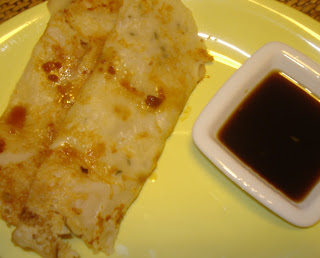
There are so many dishes which are rarely cooked even by my mother, though at one point they were common. Pithe is one of those. It is basically something prepared with Powder rice as the main ingredient. It comes in various forms, shapes and sizes. The ones that I can remember are puli pithe, chushi pithe, patishapta pithe, chetle pithe. Puli and chushi pithe are very time consuming ones. When I granny cooked it, she didn’t look at anything else in the kitchen. It was a time consuming task. Her deft hands would mould the puli, or would whizz by over the rice dough to make chushi, very similar to the haldiram sev, just imagine them broken down into much smaller sizes. Oh! Its impossible to explain. If I manage to cook it someday I will put a picture in. Anyways when my mouth waters for this, i cannot indulge. But I do manage one shortcut one, which is patishapta pithe. This is much easier version, hurriedly made and quickly finished.


Ingredients
For the pancake
Rice flour – 1 cup
Plain Flour- ¼ cup
Semolina – 3 tbsp
Condensed milk – ½ cup
Milk – about 1 cup

For the filling
Grated coconut ( frozen can be used as well) – 2 cups
Jaggery – 1 cup
Cardamon – 6/7 cloves

Method
Put the coconut in a frying pan and when heated add the jaggery to it.
Allow it to melt , all the while stirring the mixture. It will reach a consistency where the coconut starts binding together Now add the cardamom powder and let it cool.

Mix all the ingredients for the pancake. The consistency of the mixture should be about the same as dosa batter. Should not be very runny...while should not be so thick that tilting the frying pan has not effect!!!.
Heat a skillet or frying pan, add slight oil. Pour in one ladle of the batter and let it cook on one side. My granny used to flip this to other side. I don’t. Reason being I am afraid of losing the perfect round shape and end up with remains of what could have been a good patishapta. So I let it cook that extra couple second that ensures that the side facing up is not raw.
Now spread a bit of the coconut mixture in a straight line, very similar to what is called a chord in geometry. Carefully roll over the pancake over this mixture. Sometimes adding a bit of oil (though not desirable) on the sides allows easy riddance from the frying pan.

Serve it with melted patali gur or even kheer or rabri.